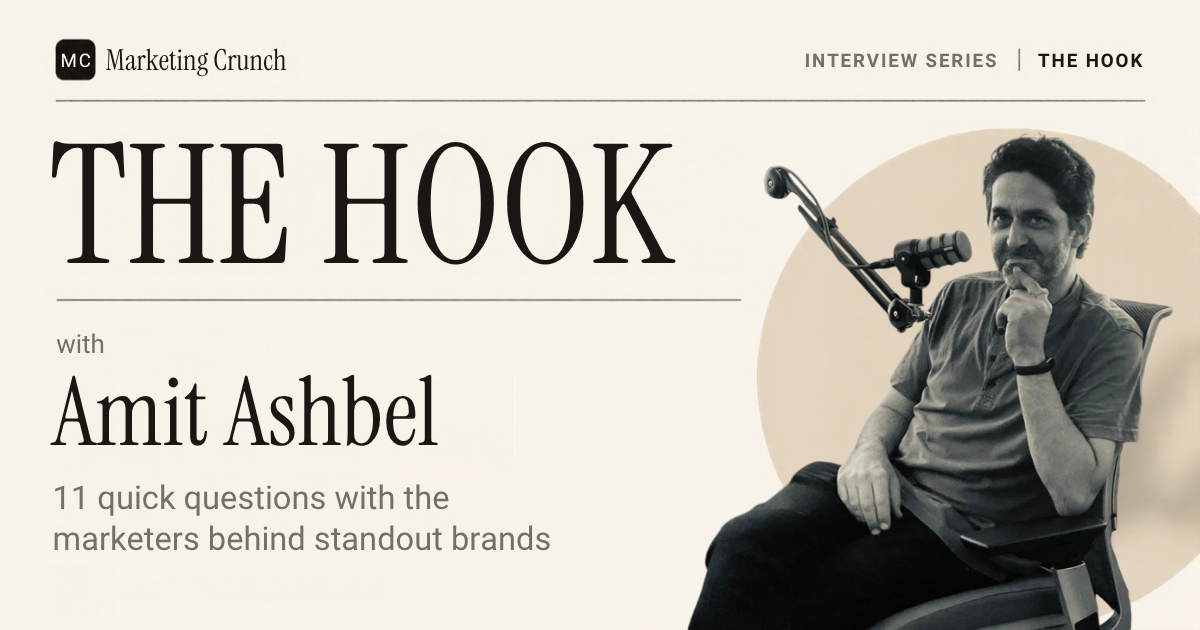
For Ashbel, a good idea executed today is worth more than a brilliant one stuck in planning. His approach centers on challenging what an audience already believes, connecting technical stories to things people recognize, and using AI to help small, talented teams make ambitious ideas possible rather than flooding channels with more content. Below, he covers the blog post that provoked one of his own customers, the security research nobody cared about, the word he would ban from every marketing deck, and the career advice that keeps marketing in perspective.
The first pitch: What was the very first thing you ever marketed?
I can’t remember the first thing I marketed, but I’ve always been fascinated by what makes people pay attention.
Why does one idea spread like wildfire while another, arguably better idea, goes absolutely nowhere?
Turns out that’s a question you can spend an entire career trying to answer. And occasionally get paid for it.
The tagline: If your career were a product launch, what would its tagline be?
“Less talking. More making things happen.”
I’ve spent most of my career in startups, where resources are limited, expectations are high, and nobody really cares how beautiful your strategy looks if nothing comes out of it.
I’ve learned that a good idea executed today is often worth more than a brilliant one stuck in planning.
Campaign envy: What’s a campaign you didn’t work on but wish you had, and what made it stick?
I don’t get to dwell on stuff I didn’t do. I am “driving.”
Signal or noise: Name one marketing trend everyone is talking about that you think is mostly noise, and one quiet one you think is real signal.
Noise: AI-generated content at scale.
Congratulations, we can now produce unlimited amounts of content nobody asked for.
Signal: What AI allows small, talented teams to accomplish.
Two good marketers with AI can now execute ideas that previously required an agency, a production team, and three months of meetings.
The opportunity isn’t to produce more garbage faster. It’s to make ambitious ideas possible.
The zero-dollar challenge: You have no budget and 30 days to make people care about a brand. What’s your first move?
Find something the audience believes and challenge it.
Not manufactured controversy. A genuine insight that makes people stop and think, “Wait, that’s actually true.”
Then find a creative way to make that insight impossible to ignore.
People share things that make them look smart, funny, or informed. Give them something that does at least one of those.
And if your idea needs a million-dollar media budget just to get noticed, perhaps it’s not such a great idea.
Best mistake: What’s the best mistake you’ve made in marketing, and what did it teach you?
Years ago, I published a blog suggesting that a few major companies had been seriously affected by malware and weren’t exactly rushing to tell the world about it.
The post got attention. Great.
The next morning, one of those companies sent us a private message on Twitter asking about the article.
Turns out they were our customer.
A small detail I probably should have checked beforehand.
I learned two things that day: provocative marketing works, and checking your customer list before provoking someone is generally recommended.
Superpower and kryptonite: What would your team say is your marketing superpower? And what would they say is your kryptonite?
Superpower: Connecting dots quickly. Finding the interesting story inside complicated technology and turning it into something people actually care about.
I’m also pretty good at taking an idea from “what if” to “let’s do it” without requiring a six-week feasibility study.
Kryptonite: Patience.
Especially with unnecessary processes, endless discussions, and meetings that could have been a decision.
I’m told patience is a virtue. Still waiting for evidence.
Unlikely muse: Where’s the most unexpected place you’ve found a great marketing idea?
Sometimes the best marketing lessons come from things that completely fail to get attention.
Early in my career, I spent considerable effort researching a technically fascinating security issue allowing direct access to CCTV cameras globally. It was important, interesting, and practically nobody cared.
Then I realized something: people don’t necessarily care about the technical significance of a problem. They care when it affects something they recognize.
Connect the exact same issue to a well-known brand, and suddenly everyone is interested.
It taught me that relevance beats technical sophistication. You can have the most fascinating research in the world, but if nobody understands why it matters to them, you’re basically talking to yourself.
The billboard: You get one billboard that every marketer in the world drives past. What does it say?
“Nobody cares about your product. Give them a reason to.”
Lightning round
- A brand you secretly admire: I don’t. It’s all a point in time. Today specifically, no commercial brand really stands out over the other. I would say the most efficient self-promotion happening globally as we speak is state-driven by Qatar and the UAE. They are everywhere. In this case, it’s a money game, not a creative game.
- A word you’d ban from every marketing deck: Unleashed. Worthless, exaggerated, and abused by every early LLM out there.
- A book or podcast you keep recommending: Neither are my thing. I learn from experience and the people around me.
- The best career advice you’ve ever received: Marketers don’t save lives. Have fun.
Pass the mic: Which marketer do you admire that we should invite to this series next, and what makes their work stand out?
At my age, I am done admiring people. I had the opportunity to work with many talented people, and a lot have climbed very high in their careers. A great example would be Paul Curran. I honestly haven’t checked up on him in a while and I’m not sure he is still in marketing, but a wild creative talent tamed by a cultural mind and a positive personality is what would best describe Paul.