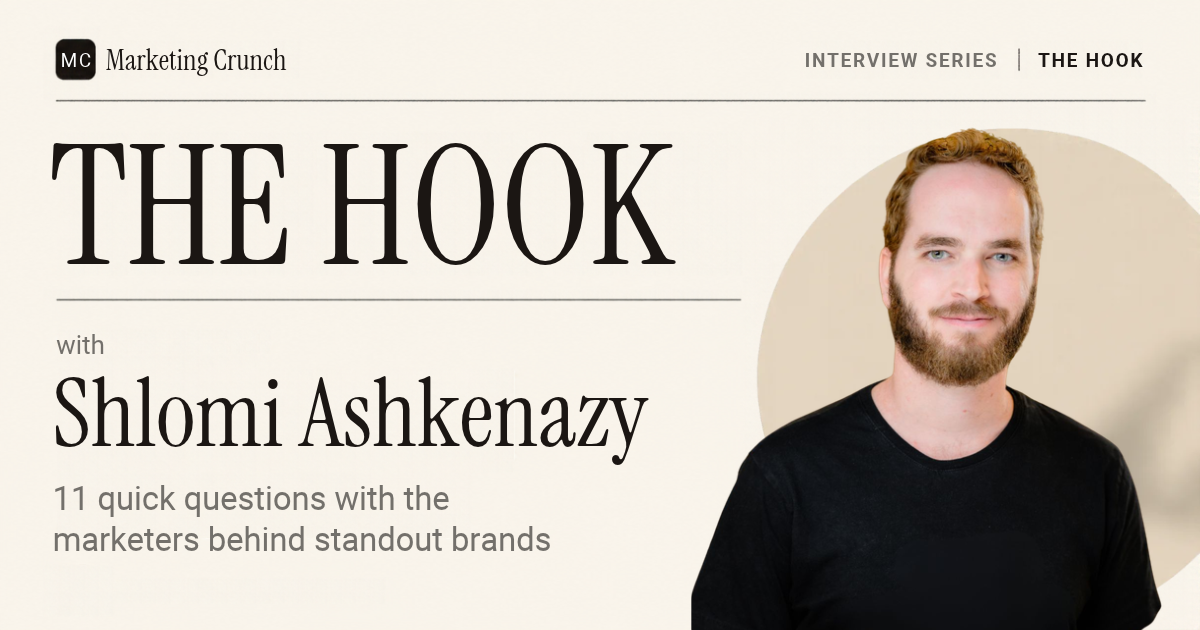
Shlomi learned his first pitching lesson at 15, talking a local bar into booking his underage rock band, and it still shapes how he works: start from the other side’s point of view. That thinking runs through his love of bold anti-marketing, his belief that community is one of the last real moats in an age of AI slop, and his favorite category play, borrowed from a mouthwash brand that turned bad breath into a medical condition. He also shares the music video that taught him to plan distribution first and the B2B marketer he calls the king of the field.
The first pitch: What was the very first thing you ever marketed?
I had a rock band when I was 15. The first pitch I remember giving was when we tried to book our first gig at a small local bar in Israel. We weren’t even allowed to drink there, let alone play there, and also the venue was extremely small. So we ended up offering them to do an afternoon show instead of an evening one (which is when the place is usually open), and said we’ll bring a lot of customers they don’t typically have. We ended up booking the gig and it was tons of fun. That was my first lesson in pitching: always think from the other side’s point of view. Never pitch by just saying how great you are.
The tagline: If your career were a product launch, what would its tagline be?
Turning great tech into movements that shape markets.
Campaign envy: What’s a campaign you didn’t work on but wish you had, and what made it stick?
I’m a huge fan of the “DLP Sucks” campaign by Jazz Security. It’s a masterclass in anti-marketing, a strategy I’ve championed for years. Whether it’s Zscaler letting booth visitors smash servers with baseball bats or Dollar Shave Club’s iconic takedown of Gillette, bold anti-branding hits exceptionally hard when done right. Jazz is executing it brilliantly.
Signal or noise: Name one marketing trend everyone is talking about that you think is mostly noise, and one quiet one you think is real signal.
Easy: AI for the sake of AI. I feel like the AI FOMO is so overwhelming that people get hung up on the wrong thing. It’s the most powerful tool ever created by mankind, true, but it’s also still a tool. The handler who uses it right is the one who wins. Just having the technical chops and adding a million AI tools won’t get you anywhere. Community, on the other hand, is way underrated. In a world of AI slop, that’s one of the only MOATs we have left in marketing: a person recommending to another person a product or a workflow. That’s all we have left, honestly.
The zero-dollar challenge: You have no budget and 30 days to make people care about a brand. What’s your first move?
I’d start with a bold brand stunt with the team, then head out to engage directly with people. For example, at Rein, where we secure AI agents in production, I’d gather the team, dress up in medical scrubs, and stand outside a major financial center or industry conference handing out free “AI Medical Kits,” complete with prompt injections and anti-hallucination pills as inside jokes for AI security. After the event, we’d hit nearby venues to connect with attendees, leveraging the stunt as the ultimate conversation starter. Repeating this three or four times in the first 30 days would build real momentum and get our name out there fast.
Best mistake: What’s the best mistake you’ve made in marketing, and what did it teach you?
I once invested heavily in a brand campaign where we rewrote a famous song, recorded custom lyrics for the industry, and shot a full music video with the marketing team. While the video turned out great, I overlooked distribution planning, which limited its reach. That experience taught me a fundamental lesson: content is only as good as your distribution plan.
Superpower and kryptonite: What would your team say is your marketing superpower? And what would they say is your kryptonite?
My superpower is definitely taking complex B2B products and turning them into a strategic narrative that guides the company, product, and marketing. It’s my bread and butter, and I’ve been fortunate enough to do it for over 60 companies, many of which later became industry leaders or achieved multi-hundred-million-dollar exits. My kryptonite? A lack of ownership. I become impatient very quickly when people don’t take full ownership of their work.
Unlikely muse: Where’s the most unexpected place you’ve found a great marketing idea?
Listerine. Back in the day, they had to convince people to use mouthwash alongside toothpaste. So, they created a movement by giving a common problem a terrifying medical name: halitosis. It redefined bad breath from a personal oversight into a clinical condition, and sales exploded. Many tech and B2B leaders have pulled off the same play since, like Tenable defining cyber “Exposure” to carve out an entirely new category. The takeaway? Sometimes the best way to sell a cure is to redefine the condition.
The billboard: You get one billboard that every marketer in the world drives past. What does it say?
Marketing sucks. Let’s fix it together.
Lightning round
- A brand you secretly admire: Notion.
- A word you’d ban from every marketing deck: Actionable Insights.
- A book or podcast you keep recommending: Anything by Scott Galloway.
- The best career advice you’ve ever received: Always make your boss look good.
Pass the mic: Which marketer do you admire that we should invite to this series next, and what makes their work stand out?
Udi Ledergor. He’s the king of B2B marketers as far as I’m concerned: sharp, no BS, always different and unbelievably likeable.